Before leaving, Alexei said:”Leave it. It’s not art. It’s an instruction manual.”

Andrei, a diplomat at the UN mission in Geneva, loved to walk. It annoyed his driver and drew knowing smirks from colleagues, but after eight hours in a negotiation room—bathed in dry light, dry phrasing, and eyes equally parched—walking was the only way to reclaim his thoughts.

That evening, he was returning from Zurich. The Mediterranean cultural platform project had officially collapsed: two delegations walked out, citing an “adverse atmosphere.” He trudged along the quay, simmering quietly, when a sudden drizzle drove him into a small gallery on Rue des Bains. He hadn’t planned to buy anything—he just craved a pause, a moment of silence.

The painting hung alone in a corner. Unframed—just a scroll, edges slightly curled on heavy paper. No bright colors; more like a blueprint rendered in ink, its lines humming with strange magnetism. Latin and Italian inscriptions crowned the top; below lay intricate details: an amphitheater, an aqueduct, a forum, fragments of faƧades, sketches of statues. Not artistry, but a hybrid—a city master plan fused with architectural drawings. The kind only an architect would draft.

“This is the master plan of central Rome under Augustus,” explained the gallery owner, a silver-haired man with spectacles on a chain. “An architectural portrait of a great empire’s strategy toward itself.”

Alexei nodded silently. Twenty minutes later, he arranged for delivery.

The painting dominated his office wall. It was impractical—too large, unframed, demanding space. Yet in that inconvenience lay its power. One couldn’t pretend not to see it. It forced you to see life whole—not in fragments or snapshots, but strategically.

Soon, Alexei noticed a shift. His notes and phrasing—once diplomatic and vague—began changing. He sketched manipulative schematics, models of codependencies, value algorithms, multi-step maneuvers. Instead of “fostering mutual understanding,” phrases emerged like: “core interests, leverage points, phased planning, tactical carrots, strategic sticks.” He mapped intellectual landscapes like he once had when negotiations held life-or-death stakes.

One evening, studying the plan, he suddenly said aloud:
“This isn’t about a city. It’s about imperial-scale influence. Influence carved in stone. Utterly impossible to ignore.”

He took a leave. Went to Tuscany—no security, no aides—renting a small house overlooking fields. Mornings, he wrote; afternoons, he drove to nearby towns. Everywhere, he sought what that blueprint revealed: axes, focal points, rhythms, hierarchies, economic resilience and cultural aggression. He began assembling a concept: how to unite cultural institutions across nations through architectural language, not formal memoranda. The Rome plan was a unification algorithm—a case study to adapt.

When his curator friend from Paris visited, Alexei showed him the painting.
“Playing curator now?” the friend smirked.
“I’m seeking a form—a vessel for meaning—to speak not of conflict, but of this world’s foundations.”
“And Rome’s master plan helps?”
“It reminds us: anything built to last demands the strictest, highest logic.”

Six months later, at a London exhibition in the Architecture Museum, that same scroll hung under glass in the curator’s section: “Imago Urbis: How Cities Shaped Civilizations.” Beneath it lay Alexei’s booklet pitching his project. The signature was simple: Aleksei Agafonov, strategist.

Three days after, he signed a contract with UNESCO. Now he oversaw a program for cultural infrastructure, weaving museums, urban schools, and small towns into chains of global cultural influence.

His Geneva office belonged to another now. Only one thing still hung on the wall: the scroll.

Before leaving, Alexei said:
“Leave it. It’s not art. It’s an instruction manual.”

šŸ”„ Buy my big paintings. https://taplink.cc/kichigineduard
šŸ”„ Write to my manager Olga https://www.instagram.com/olgamoskvina.verde/
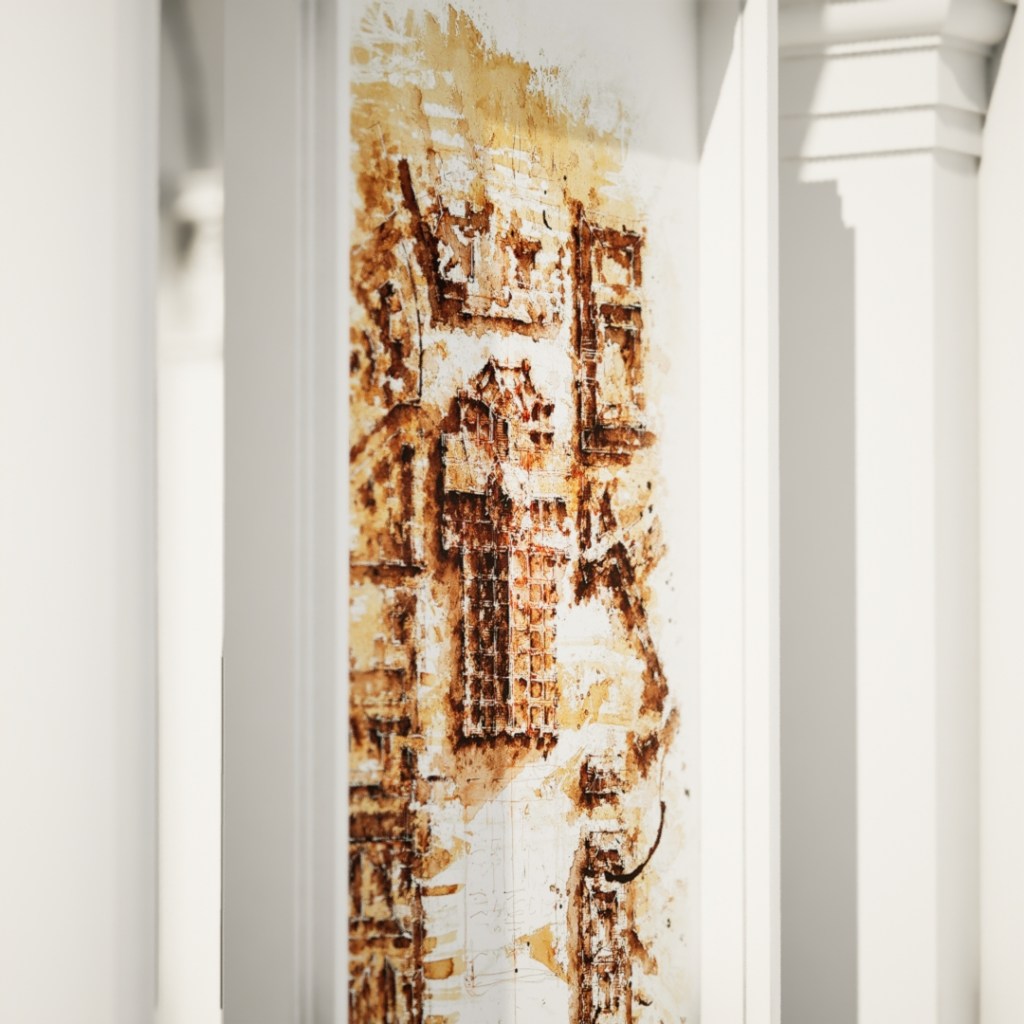
A few years ago, at an art fair in Moscow, his eye caught on a piece: ā€œMaster Plan of Rome in the Age of Augustus.ā€

A few years ago, at an art fair in Moscow, his eye caught on a piece: ā€œMaster Plan of Rome in the Age of Augustus.ā€ Precise lines, austere minimalism, architectural rigor, handwritten Italian notes. He bought it instantly — it was aesthetic, a reminder of Italy, and a statement piece for his office overlooking Moscow City. ā€œIntellectual. My style,ā€ he thought.

At first, it was just background. Then it became the center of gravity. His gaze kept returning to the traces of the Appian Way, the outline of the Forum, the threads of aqueducts. During tense negotiations over a 15-year development project, his eyes drifted toward it — and he suddenly paused: ā€œHow long did the Romans plan this aqueduct to last? A hundred years? Five hundred? A thousand? More? What did they KNOW about eternity that I’m still refusing to face?ā€ His own project began to feel short-lived in contrast to this centuries-long strategy of intellect, stone, and will.

The painting became a mirror — not of strategy, but of paradox. Urban genius, infrastructure that outlived the empire… yet the Empire itself collapsed. They laid the foundation of Europe but failed to preserve it. The very institutions that shaped civilization couldn’t withstand their own expansion. The master plan embodied the boldness of practical vision across centuries — and the fragility of human systems. ā€œAm I building a skeleton or just a faƧade? What will remain when my company fades into obscurity?ā€ These questions now hung in the air of his office.

It wasn’t about ā€œthinking a hundred years ahead.ā€ It was a tectonic shift. Now, when evaluating a project, he asked: ā€œWill this still function in 50, 100, 200 years?ā€ And when he could dare to imagine adding ā€œ500ā€ or even ā€œ1000ā€ to that list — he felt a rare kind of happiness. Could the idea even hold that weight, even in theory? What systems was he embedding that might serve future generations? Would they stand the test of time — of politics, economics, disasters, and people?

He began investing in long-term frameworks, in architectural ensembles, resilient infrastructures, social fabrics — all the deep structures of true planning, built to outlive him. A strange kind of selflessness crept in — something he’d never felt before. The painting didn’t offer answers. It asked uncomfortable questions in the language of eternity, reminding him that true value doesn’t lie in square meters — but in the chance to leave behind stones that speak of your life’s work to generations ahead.

Some paintings decorate walls. Others — like this master plan — redraw the limits of thought, pushing us to build not just buildings, but our own chances at eternity.
Eduard Kichigin

šŸ”„ Buy my big paintings. šŸ”„ Write to my manager Olga https://www.instagram.com/olgamoskvina.verde/
šŸ”„ My very simple and very effective quick šŸ”„ drawing lessons http://patreon.com/kichigin
šŸ”„ My NFT art 😃 Amazing drawing in 3D space https://rarible.com/Eduard_Kichigin
šŸ”„ My store: šŸ‘• clothes and accessories with my drawings. https://ink-and-pen-graphics-drawing.creator-spring.com/

Aesthetics versus ideas: what matters more in art?

Why does one artwork captivate us while another leaves us cold? The answer lies in two forces: visual beauty and intellectual depth. But which is more important? Let’s explore. Visual beauty grabs us first. Vibrant colors, harmonious lines, perfect composition.


Studies show our brains respond to symmetry and balance, releasing endorphins. A painting can mesmerize through form alone, even if its meaning escapes us. Take Kandinsky’s or Rothko’s abstract canvases: their color fields draw us in, even if we’re not hunting for hidden messages. Beauty works instantly, on instinct. But art isn’t just about surface impact. Intellectual depth makes us think, question, seek meaning. Conceptual works, like Ai Weiwei’s installations, spark reflections on freedom, society, human nature. They demand time and attention but leave a lasting mark on the mind. Research confirms: when we unravel art’s meaning, brain regions tied to problem-solving and creativity light up.

So, can we love art just for its beauty, ignoring its ideas? Sure, but that’s only half the experience. Beauty delivers instant pleasure; ideas feed thought. One without the other is like a painting without a frame: striking, but incomplete. Art becomes powerful when these forces merge, blending form and substance in harmony. Ask yourself: what hooks you—beauty’s emotion or the challenge of ideas? Art offers no right answers, but it compels us to search. Aesthetics versus ideas: what matters more in art?

šŸ”„ Buy my big paintings. šŸ”„ Write to my manager Olga https://www.instagram.com/olgamoskvina.verde/
šŸ”„ My very simple and very effective quick šŸ”„ drawing lessons http://patreon.com/kichigin
šŸ”„ My NFT art 😃 Amazing drawing in 3D space https://rarible.com/Eduard_Kichigin
šŸ”„ My store: šŸ‘• clothes and accessories with my drawings. https://ink-and-pen-graphics-drawing.creator-spring.com/

Art as a Reflection of Identity

Why do some paintings, sculptures, or melodies grip us while others leave us cold? The answer lies in how art mirrors our sense of self. Every work we choose is a reflection of our personality, history, and values. Studies show people gravitate toward art that resonates with their experiences. A person raised by the sea might linger over Aivazovsky’s seascapes, stirred by memories of salty breezes.


Another, thriving in a bustling city, might pick Banksy’s graffiti, seeing their life’s rhythm in its lines. It’s not just taste—it’s our identity, encoded in colors and shapes.Art doesn’t just reflect us; it shapes us. Choosing a favorite painting or song is a declaration to the world of who we are. A teenager blasting punk rock isn’t just enjoying music—they’re signaling rebellion, a search for self. A woman collecting African masks underscores her connection to her roots. Through art, we craft our story, staking a claim to a culture or community.More than that, art becomes a tool for self-discovery.

Artists often pour their identity into their work—think of Frida Kahlo’s self-portraits, where every detail screams her pain and strength. When we choose such works, we adopt their meaning, weaving it into our lives. Art isn’t just about beauty. It’s our way of saying, ā€œThis is who I am.ā€ It helps us understand ourselves, find our place in the world, and speak without words. By choosing art, we choose ourselves. Art is our portrait, painted not by us, but for us.

šŸ”„ Buy my big paintings. šŸ”„ Write to my manager Olga https://www.instagram.com/olgamoskvina.verde/
šŸ”„ My very simple and very effective quick šŸ”„ drawing lessons http://patreon.com/kichigin
šŸ”„ My NFT art 😃 Amazing drawing in 3D space https://rarible.com/Eduard_Kichigin
šŸ”„ My store: šŸ‘• clothes and accessories with my drawings. https://ink-and-pen-graphics-drawing.creator-spring.com/

Why does a single piece of art make one person weep and another laugh?

Why does a single piece of art make one person weep and another laugh? Is art a universal language or a personal mirror? Let’s explore. Each of us views a painting, sculpture, or photograph through the lens of our own experience. Neuroscience confirms: our brain ties visual images to personal memories. A rainy street in a painting might evoke your first love or a fight with a friend. This isn’t random. Studies show that brain regions linked to emotions and memory light up when we encounter art. The same landscape can mean nostalgia for you, loneliness for someone else.


Cultural context matters too. In 2018, Stanford researchers found that cultural norms shape how we perceive colors and forms in art. A Japanese viewer might see passion in a red hue, a European, danger. Even symbols shift: a skull means death in Western culture, celebration in Mexican tradition. Art doesn’t dictate emotions—it triggers them, like a catalyst, through your unique experience.

But is there universality? Take Van Gogh’s Starry Night. Its swirls and colors stir awe in millions, regardless of culture. Neuroaesthetics explains: our brains respond to harmony in composition and color, sparking a shared sense of wonder. Yet the emotions remain personal—one sees hope, another chaos. Art isn’t a universal code we all read the same. It’s a mirror reflecting your inner world and a bridge connecting us through shared feelings. But what if this duality is what makes art so powerful? It doesn’t impose—it invites. And that’s its strength. Art doesn’t tell you what to feel—it reminds you who you are.

šŸ”„ Buy my big paintings. šŸ”„ Write to my manager Olga https://www.instagram.com/olgamoskvina.verde/
šŸ”„ My very simple and very effective quick šŸ”„ drawing lessons http://patreon.com/kichigin
šŸ”„ My NFT art 😃 Amazing drawing in 3D space https://rarible.com/Eduard_Kichigin
šŸ”„ My store: šŸ‘• clothes and accessories with my drawings. https://ink-and-pen-graphics-drawing.creator-spring.com/

How do you tell a strategist from a dreamer?

How do you tell a strategist from a dreamer?At first glance, all exhibition visitors seem alike: they stroll slowly through the hall, pause, study the works, read the labels. But linger near them a moment longer, and you’ll notice a chasm between what they do and how they do it. Some glance at a painting and immediately hunt for the price tag or material. Others read the label and ask a shallow questionā€”ā€œIs that a temple?ā€

But then there’s the one who freezes, slipping into a long, inward pause, as if their focus isn’t on the image but on something stirring in their mind. Unlike the first two, this person doesn’t see a mere picture but a system of coordinates. A painting of Florence’s city center isn’t just streets and a dome. It’s a blueprint for controlling space, time, crowd behavior, perception, even historical memory, laid down by an ancient architect. Those fixated on beauty or price will approach any project the same way—quickly, superficially, task to task.

But those who unravel the logic—where’s the entrance, the exit, why this design, how it shapes people’s lives—are likely to act the same in life. And here we reach the first key insight: the quality of one’s interpretation of an artistic image is a hidden marker of their cognitive model. Some seek answers. Others know how to wrestle with questions. And in that difference lies everything.

šŸ”„ Check out my gallery of unique 🤩 large architectural paintings . https://eduardkichigin.tilda.ws/italy
šŸ”„ My very simple and very effective quick šŸ”„ drawing lessons http://patreon.com/kichigin

The second point is about reading context—a vital skill for any strategist.

The second point is about reading context—a vital skill for any strategist. It’s not about inventing something from scratch but understanding the field you’re in, its rules, and the logic embedded before you. My paintings do exactly that: they depict cities as intricate constructs, shaped by centuries. These aren’t artistic fantasies; they’re blueprints tested by the harshest realities of life, weaving together everything from engineering to ritual. Someone who can read such constructs doesn’t need micromanagement.

They grasp the rules through structure. They don’t invent meaning—they uncover it. This means they can work within an existing system: amplifying, refining, evolving it. Meanwhile, a dreamer tries to impose their idea on a city, blind to the fact that any clash with its historical code will destroy both the idea and its author.

This is the second key marker: the ability not just to see structure but to align yourself with it. You see it in the questions people ask at an exhibition. Do they inquire about the time of construction or its context? Do they notice the interplay between architectural elements and their social, economic, or political roles? Or is their only question, ā€œWhy was it painted like that?ā€ Their questions predict their role in any collective project.

šŸ”„ Check out my gallery of unique 🤩 large architectural paintings . https://eduardkichigin.tilda.ws/italy
šŸ”„ My very simple and very effective quick šŸ”„ drawing lessons http://patreon.com/kichigin

The impact of an art exhibition lies in perceiving complex information without explicit guidance.

The impact of an art exhibition lies in perceiving complex information without explicit guidance. My paintings aren’t ā€œart in a frameā€ā€”they’re large-scale architectural manifestos. They demand to be read, not just visually but textually, engaging cultural and historical codes. There are no detailed captions on the wall. Everything is embedded within the canvas: place names, architects and patrons, historic city centers, master plan axes, the logic of urban development.


The viewer faces a challenge: to immerse themselves in this visual-semantic web without clues. This activates their cognitive machinery. Within 10–15 minutes, they either shift into an exploratory mode, give up, or start pretending to understand. This reveals their cognitive flexibility—the ability to interpret an environment without instructions. It’s a high-order skill, crucial in leadership, investments, and navigating uncertainty. Someone capable of such navigation can engage in autonomous analysis, grasp context, and discern subtle interconnections.

An exhibition, unlike a presentation, meeting, or dialogue, offers a unique way to gauge this skill silently. The paintings set a bar, and by observing how someone responds, you can predict how they’ll handle complex, ruleless systems.

šŸ”„ Check out my gallery of unique 🤩 large architectural paintings . https://eduardkichigin.tilda.ws/italy
šŸ”„ My very simple and very effective quick šŸ”„ drawing lessons http://patreon.com/kichigin

Finally, the third shared quality is the ability to maintain reputational poise in an environment dense with meaning.

Finally, the third shared quality is the ability to maintain reputational poise in an environment dense with meaning. An exhibition, especially one of the caliber showcasing grand architectural drawings of Italian cities, is not merely a visual experience—it’s a cultural trial. The moment someone steps into the hall, they reveal whether they can command themselves. How they move, where they look, what they respond to, and how deeply they grasp the significance of what’s before them. This isn’t about aesthetic pleasure—it’s about self-discipline. Here, as in a negotiation room, there’s no room for randomness.

You must be clear without speaking, adept at reading subtle signals, and capable of taking the right stance—not through dominance, but through precision and versatility in interpreting the moment. An exhibition is a training ground for reputational posture. It reveals how someone navigates an intellectual space where direct questions are absent, yet cultural meaning is thick.

If you can hold your own in this space—composed, perceptive, attuned—you can handle complex communication. After all, a painting, like a high-stakes conversation, isn’t an object but a field of endless possibilities. You can’t conquer it, but you can align with it. In this way, exhibitions and negotiations are two expressions of the same skill: being legible yet perceptive, and crafting your own strategy.

šŸ”„ Check out my gallery of unique 🤩 large architectural paintings . https://eduardkichigin.tilda.ws/italy
šŸ”„ My very simple and very effective quick šŸ”„ drawing lessons http://patreon.com/kichigin

What happens to a person inside a gallery of paintings?


We often think art is about taste, curiosity, or cultural refinement—that an exhibition is a space for passive observation: you walk in, look, and form an opinion. But in reality, an exhibition is a powerful projective test, where the paintings don’t speak about themselves—you speak about yourself. The first thing that emerges is your stance toward the environment.

You step into a space filled with grand images of cities, where the core principles of Western civilization took shape, and instantly face a choice: engage with the context or push back. Some immediately find a point of respect, entering a dialogue with architectural logic, history, names, and scale. Others, though, react with arrogance: ā€œWhat’s so special here?ā€ ā€œThis is outdated.ā€ ā€œI could’ve done this myself.ā€ Or they retreat into silent detachment. These are all indicators—signals that surface in negotiations, teamwork, or strategic projects.

Your behavior in the gallery mirrors how you navigate a complex, meaning-rich environment without external pressure. It perfectly reveals how you respond to ambiguous signals, cultural hierarchies, and spaces where the goal isn’t to win but to hear and listen. Free from the weight of responsibility, you show who you truly are.

šŸ”„ Check out my gallery of unique 🤩 large architectural paintings . https://eduardkichigin.tilda.ws/italy
šŸ”„ My very simple and very effective quick šŸ”„ drawing lessons http://patreon.com/kichigin